

Your injury isn’t just a medical file to an insurance adjuster; it’s a liability they’re programmed to minimize. While you’re focused on healing, they’re likely using aggressive tactics to find reasons to devalue your pain and protect their bottom line. Understanding how to file a personal injury claim in california is the first step in shifting the power back to you. You’ve probably realized that the system feels stacked against you, especially as medical debt climbs and legal deadlines loom closer every day. It’s a chaotic situation that demands a definitive professional response.
We’re here to act as your shield and ensure you aren’t forced to accept a substandard resolution. This 2026 guide will show you how to master the complex California legal process and protect your right to maximum compensation after an accident. You’ll learn why the two-year statute of limitations is non-negotiable, how the 2025 increase in minimum liability coverage to $30,000 impacts your case, and how to navigate the state’s pure comparative negligence rules. We’re providing a clear roadmap to help you avoid common mistakes and secure a settlement that covers every future need.
Key Takeaways
- Act fast to close the “Medical Gap” and stop insurance adjusters from using delayed treatment as an excuse to lower your payout.
- Spot the hidden legal traps in 2026, including the strict six-month deadline for claims against government entities.
- Master the tactical steps for how to file a personal injury claim in california to ensure your demand letter commands the attention it deserves.
- Move beyond simple paperwork by learning how the discovery process forces defendants to reveal evidence they would rather keep hidden.
- Leverage professional grit and local expertise to stand up against powerful entities and secure a future-proof settlement.
Immediate Steps to Protect Your Rights After a California Accident
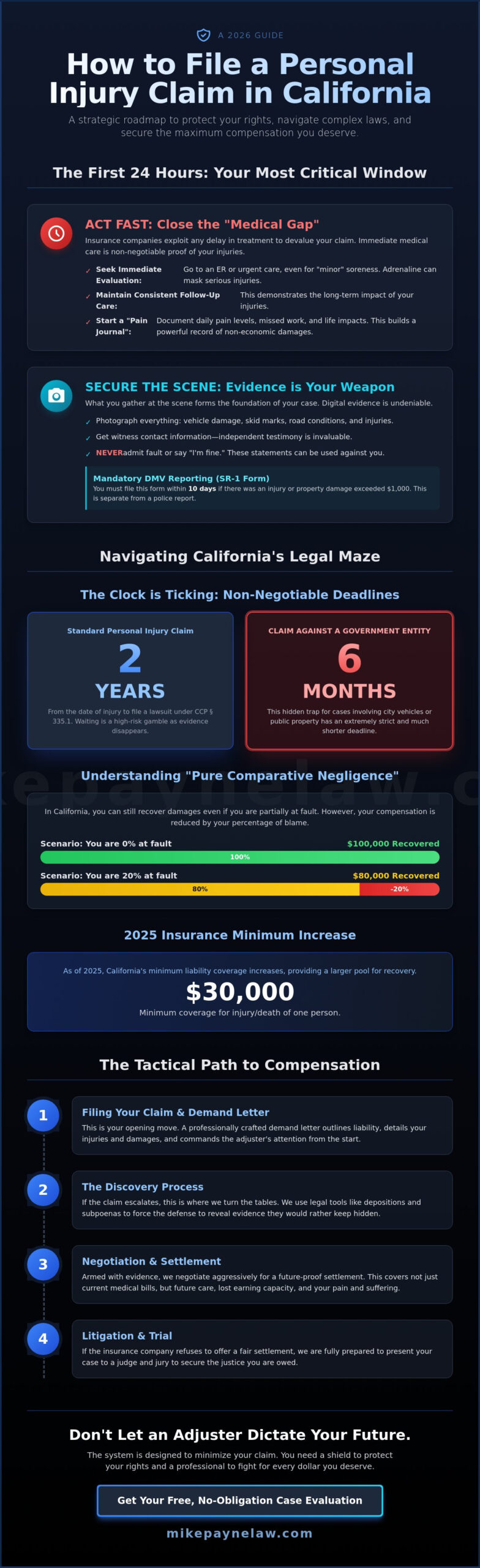
The moments following a crash or a fall are chaotic, but they are also the most critical for your future. Insurance adjusters are already moving to protect their company’s profits. You must move faster to protect your family. The first 24 hours determine the trajectory of your financial recovery. If you don’t secure evidence and medical proof immediately, you’re giving the insurance company a head start they don’t deserve. Understanding the foundations of personal injury law is vital, but the physical evidence you gather right now is what actually wins cases. We act as your shield during this vulnerable time, ensuring you don’t fall into the traps set by aggressive adjusters.
One of the most dangerous traps is the “Medical Gap.” Insurance companies look for any delay in treatment to argue that your injuries aren’t serious or happened elsewhere. If you wait even a few days to see a doctor, they’ll use that gap to devalue your claim. Beyond medical care, you have strict reporting requirements. In California, you must file an SR-1 form with the DMV within 10 days if anyone was injured or property damage exceeds $1,000. This is a separate requirement from a police report, which provides a critical third-party account of the motor vehicle accident. Knowing how to file a personal injury claim in california starts with these procedural wins.
Prioritizing Medical Documentation
Go to the doctor immediately. Even if you think you’re just “sore,” seek a professional evaluation at local SoCal facilities like Queen of the Valley or Pomona Valley Hospital. Adrenaline masks serious internal damage. Your initial ER visit is just the start; consistent follow-up care is what proves the long-term impact of your injuries. We recommend starting a “Pain Journal” on day one. Document your daily pain levels, missed work hours, and the activities you can no longer enjoy. This creates a real-time record of non-economic damages that an adjuster cannot easily dismiss as an exaggeration later.
Evidence Collection at the Scene
Digital evidence is your best weapon against a “he-said, she-said” defense. Use your phone to capture everything. Photograph property damage from multiple angles, skid marks on the asphalt, and environmental factors like obscured stop signs or broken traffic lights. Secure witness contact information before they leave the area. Their independent testimony is often the deciding factor in proving liability. Most importantly, watch your words. Never admit fault or say “I am fine” to the other driver. These statements are often recorded and used as admissions to sink your case before it even begins. Protecting your right to maximum compensation requires professional grit from the very first second.
Navigating California Personal Injury Laws and Deadlines
Missing a legal deadline is the fastest way to lose your case before it even starts. In the legal world, these deadlines are absolute. If you fail to act within the prescribed window, California law permanently bars you from seeking compensation, regardless of how severe your injuries are. For those who suffered an accident in 2024, 2026 is the critical “cliff” year. This is when the standard clock runs out for most claims. We don’t let our clients get backed into a corner by these timelines. We step in as your primary shield, ensuring every filing is precise and every right is protected against aggressive defense teams.
The rules of the road and the rules of the courtroom are equally complex. While the California Department of Insurance provides a baseline for auto coverage, the actual litigation process requires a deep understanding of liability theories. Most cases rest on negligence, but some, like dog bites or defective products, may fall under strict liability. This means you don’t always have to prove the other party was “careless” if the law already holds them responsible for the outcome. Knowing these distinctions is a fundamental part of how to file a personal injury claim in california effectively.
California’s Statute of Limitations in 2026
Under California Code of Civil Procedure section 335.1, you generally have two years from the date of the injury to file a lawsuit. However, waiting until the final months of this window is a dangerous gamble. Evidence disappears, and witnesses move away. If your accident involved a city vehicle, a broken sidewalk, or any government property, the rules change completely. You have a mere six months to file a formal administrative claim under the Government Claims Act. Missing this 180-day window is a “trap” that catches many unrepresented victims. If you are unsure which timeline applies to your situation, it’s time to speak with a personal injury attorney who understands these local rigors.
Comparative Fault and Your Settlement
California follows a “pure” comparative negligence rule. This is a powerful tool for victims because it means you can recover damages even if you were 99% at fault for the incident. Your total recovery is simply reduced by your percentage of blame. For example, if your damages are $100,000 but a jury finds you 20% responsible, you still walk away with $80,000. Insurance adjusters know this and will fight tooth and nail to shift even a small percentage of blame onto you. They use recorded statements and social media posts to chip away at your settlement value. We fight back against these tactics by building a wall of evidence that keeps the focus where it belongs: on the party who caused your harm. If you’re facing unfair blame, reach out to us to discuss how we can protect your financial future.
The Tactical Process of Filing Your Insurance Claim
Filing a claim isn’t a mere administrative hurdle; it’s a tactical offensive against a multi-billion dollar industry. When you initiate the process of how to file a personal injury claim in california, you’re essentially declaring that you won’t be a victim twice. You’ll likely deal with two different entities: your own insurance company for immediate needs like MedPay and the “at-fault” carrier for the bulk of your damages. Don’t confuse the two. Your own insurer has a contractual duty to you, but the other side’s adjuster has one goal: to close your file for as little as possible.
Timing is everything. You must reach Maximum Medical Improvement (MMI) before even discussing a settlement. MMI is the point where your condition has stabilized and further healing is unlikely. If you settle before this stage, you’re guessing at your future medical costs. If those costs end up being higher than expected, you can’t go back for more. Insurance companies love to rush this process. They want you to sign a release while you’re still in pain and under financial stress. We stop that momentum. We ensure the full scope of your recovery is understood before a single dollar is negotiated.
Drafting a Compelling Demand Package
A weak demand letter results in a lowball offer. Your demand package must be an undeniable volume of evidence that leaves the adjuster with no room to maneuver. It should include:
- Itemized Economic Damages: Every medical bill, pharmacy receipt, and proof of lost wages from your employer.
- Non-Economic Quantification: We translate your “Pain and Suffering” into a figure that reflects current California jury trends.
- Expert Substantiation: We often include accident reconstruction data or medical expert reports to prove liability and the extent of your injuries beyond a doubt.
Dealing with Insurance Adjusters
Adjusters are trained to be your “friend” while looking for ways to sink your case. They’ll often ask for a “recorded statement” to get your side of the story. Decline it immediately. They’re searching for inconsistencies to use against you during the motor vehicle accident claim process. Michael Payne’s background in insurance defense gives our clients a massive advantage. He knows the “Delay, Deny, Defend” playbook because he’s seen it from the inside. We anticipate their rebuttals before they even make them, turning their own tactics against them to secure the justice you deserve. If you’re tired of being ignored by an adjuster, contact us today to level the playing field.
Escalating to Court: When an Insurance Claim Becomes a Lawsuit
When an insurance company refuses to offer a fair settlement, the negotiation phase ends and the litigation phase begins. Moving your file from an adjuster’s desk to the Superior Court is a decisive step that signals you’re ready for a high-stakes confrontation. This is a critical transition in how to file a personal injury claim in california. It forces the insurance company to stop using lowball algorithms and start considering the real-world cost of a full-scale trial. We don’t just file paperwork; we prepare for battle. This readiness for trial is often the very thing that forces a carrier to finally offer a settlement that covers your long-term medical needs.
Litigation isn’t just about the courtroom; it’s about leverage. By filing a formal Complaint, we initiate a process that includes Mandatory Settlement Conferences (MSC) and mediation. In Southern California, these meetings are designed to resolve cases before they reach a jury. However, the defense only negotiates fairly when they know the attorney on the other side isn’t afraid of a verdict. We maintain an aggressive posture from day one, ensuring the opposition knows that we’re fully prepared to pursue the most rigorous path to justice.
Navigating Local Southern California Courts
Your case’s potential value can change based on the venue where it’s filed. Filing in the West Covina or Pomona courthouses requires a deep understanding of local judicial leanings and regional values. Similarly, the San Bernardino Superior Court has its own specific procedural rigors that can impact the trajectory of regional accident cases. Venue selection is a strategic move, not just a logistical one. We understand how local juries in these communities perceive liability and damages, which allows us to position your claim for the highest possible award. If you’re dealing with a fatal trucking accident or a complex injury, these local nuances become even more vital.
The Discovery and Deposition Phase
The discovery phase is where we strip away the defense’s secrets. We use Interrogatories and Requests for Production to force the defendant to hand over internal records and evidence they’d rather keep hidden. This phase is about getting the truth in writing. Preparing for your deposition is equally vital to your success. We act as your primary shield during this process, helping you stay calm, confident, and consistent under pressure. Often, a well-handled deposition of the at-fault driver leads to immediate settlement breakthroughs. When the defendant is forced to admit their mistakes under oath, the insurance company’s defense often crumbles. If the insurance company is playing games with your recovery, contact our aggressive litigation team to discuss taking the fight to court.
Securing Maximum Compensation with the Law Offices of Michael D. Payne
Choosing the right representation is the final and most important decision in your legal journey. You’ve seen the deadlines, the complex filing requirements, and the aggressive tactics adjusters use to devalue your pain. Now, you need a professional champion who can execute the strategy. At the Law Offices of Michael D. Payne, we bring over 25 years of aggressive litigation experience to the table. We don’t just understand the law; we understand the opposition. Michael Payne’s background in insurance defense provides an “insider” perspective that most firms lack. We know exactly how the other side evaluates risk, and we use that knowledge to level the playing field for our clients.
We treat every client as a person with a story, not just another file number on a desk. This boutique approach means you get personalized advocacy from a relatable fighter who is personally invested in your recovery. Whether you’re dealing with a fatal trucking accident or a complex premises liability case, we act as your primary shield. You don’t have to worry about the cost of justice, either. We operate on a contingency fee basis, which means you pay nothing unless we win your case. It’s a foundational promise that ensures our interests are perfectly aligned with yours.
Why a Trial-Ready Advocate Matters
Insurance companies maintain databases on every attorney. They know which lawyers settle for the first lowball offer and which ones are ready to go to the finish line. Michael Payne has built a reputation for trial readiness that forces adjusters to take our demands seriously. When we explain how to file a personal injury claim in california, we aren’t just talking about filling out forms. We’re talking about building a case that can withstand the scrutiny of a jury in West Covina or San Bernardino. We fight for settlements that cover not just your current bills, but your future medical needs and any long-term disability resulting from the accident.
Getting Started with Your Claim Today
The path to justice starts with a single, definitive action. We handle all communication with insurance companies so you can focus entirely on your physical and emotional healing. When you’re ready to take the next step, gather your police reports, medical records, and any scene photos you’ve collected. These documents are the building blocks of a successful claim. Contact the Law Offices of Michael D. Payne today to start your recovery journey. We’re ready to stand by your side and pursue the maximum compensation you deserve under California law.
Take Control of Your Recovery and Secure Your Future
The road to recovery is paved with complex legal requirements and aggressive insurance tactics designed to stop you. You now have the strategic roadmap for how to file a personal injury claim in california, from securing immediate medical proof to navigating the high-stakes environment of a Southern California courtroom. Every decision you make today, from seeking consistent follow-up care to respecting the strict six-month government claim window, directly impacts the value of your final settlement. You don’t have to face these powerful entities alone while you’re trying to heal.
Michael Payne offers a unique advantage as a former insurance defense attorney with over 25 years of experience. He knows the secret playbook the other side uses to devalue your pain and minimize your payout. Our firm operates on a contingency fee basis, so there is no recovery and no fee. We act as your primary shield, handling the adjusters and the legal filings so you can focus on getting your life back. Contact the Law Offices of Michael D. Payne for a free consultation today. You deserve a professional champion who will fight for the maximum compensation your family needs. Justice is within reach.
Frequently Asked Questions
How much does it cost to file a personal injury claim in California?
You can file a claim with zero upfront costs by working with an attorney on a contingency fee basis. This means we cover all the investigative expenses, filing fees, and expert witness costs required to build your case. You don’t pay any legal fees unless we successfully recover a settlement or verdict for you. It’s a risk-free way to ensure you have a professional champion fighting against powerful insurance companies from day one.
What is the average settlement for a personal injury claim in SoCal?
Settlement amounts vary significantly based on your medical expenses, lost income, and the severity of your injuries. Every case is unique, and factors like the available insurance policy limits also play a major role. For example, as of 2026, the minimum bodily injury liability in California is $30,000 per person. We focus on securing a settlement that covers your full scope of future needs rather than accepting a quick, substandard resolution.
Can I file a claim if I was partially responsible for the accident?
Yes, you can still recover compensation even if you were partially at fault for the incident. California follows a pure comparative negligence rule, which allows you to seek damages regardless of your percentage of blame. Your total award is simply reduced by your share of the fault. Understanding how to file a personal injury claim in california under these rules is vital for protecting your right to a fair recovery.
How long do I have to file a personal injury lawsuit in California?
The general deadline is two years from the date of the injury under California Code of Civil Procedure section 335.1. However, if your claim involves a government entity, you have a much shorter window of only six months to file an administrative claim. Missing these deadlines will permanently bar you from seeking justice. It’s a chaotic situation that requires immediate professional action to ensure no critical dates are missed.
Do I have to go to court to win my personal injury case?
Most personal injury claims are resolved through settlements without ever stepping into a courtroom. We use aggressive negotiation tactics and comprehensive demand packages to force insurance companies to pay fairly. However, our trial readiness is what gives us leverage during these negotiations. If the insurance company refuses to offer a just amount, we are fully prepared to take your case to the Superior Court to protect your interests.
What damages can I recover in a California injury claim?
You are entitled to recover both economic and non-economic damages resulting from your accident. Economic damages cover tangible losses like hospital bills, rehabilitation costs, and lost wages. Non-economic damages compensate you for intangible suffering, such as physical pain, emotional distress, and loss of enjoyment of life. We itemize every single loss to ensure the insurance company sees the true human cost of their policyholder’s negligence.
Should I accept the first settlement offer from the insurance company?
Accepting the first offer is a mistake that usually leaves a significant amount of money on the table. Adjusters often make “lowball” offers early in the process, hoping you’ll sign a release before the full extent of your injuries is known. You should never settle until you have reached Maximum Medical Improvement. We use our former defense experience to spot these tactics and push for a resolution that reflects your actual long-term needs.
How long does the personal injury claim process usually take?
The timeline for how to file a personal injury claim in california and reach a resolution can range from several months to over a year. Simple cases with clear liability may settle quickly, while complex litigated cases take longer to move through the court system. The duration depends largely on the length of your medical treatment and the willingness of the insurance carrier to negotiate fairly. We maintain a decisive pace to keep your case moving forward toward justice.