

The first ten minutes after a collision on the I-10 or Azusa Avenue aren’t just about survival; they’re the most expensive ten minutes of your life if you make a single mistake. You’re likely feeling the crushing weight of medical bills and the fear that an insurance adjuster will twist your words to pin the blame on you. It’s a heavy burden to carry when you’re just trying to get back on your feet. I know that anxiety, and I’m here to tell you that you don’t have to face it alone. I’ve spent my career acting as a shield for people in your exact position.
This guide breaks down exactly what to do after car accident in West Covina to protect your health and secure the maximum compensation you deserve under 2026 California statutes. In 2025, over 3,500 local residents faced similar chaos, and those who followed a strict protocol saw significantly higher recovery rates. I’m going to show you how to act as your own first line of defense. We will walk through the critical steps of scene documentation, the 48-hour medical window you can’t afford to miss, and the specific legal actions that turn a confusing crash into a winnable case. You’ve been through enough; now it’s time to fight back.
Key Takeaways
- Secure your safety on the I-10 or 60 freeway and learn the immediate steps to take before the chaos of a West Covina crash escalates.
- Master the “Big Picture” evidence checklist to capture professional-grade documentation that insurance companies cannot ignore.
- Prioritize your recovery by identifying “hidden injuries” and learning exactly what to do after car accident impacts to secure your health and your claim.
- Protect your right to maximum compensation by recognizing the “Friendly Adjuster” trap and avoiding the common mistakes that sink legal cases.
- Discover how Mike Payne Law fights for your justice with a trial-ready strategy and a firm promise that you pay nothing unless we win.
Immediate Steps for Safety and Scene Management in West Covina
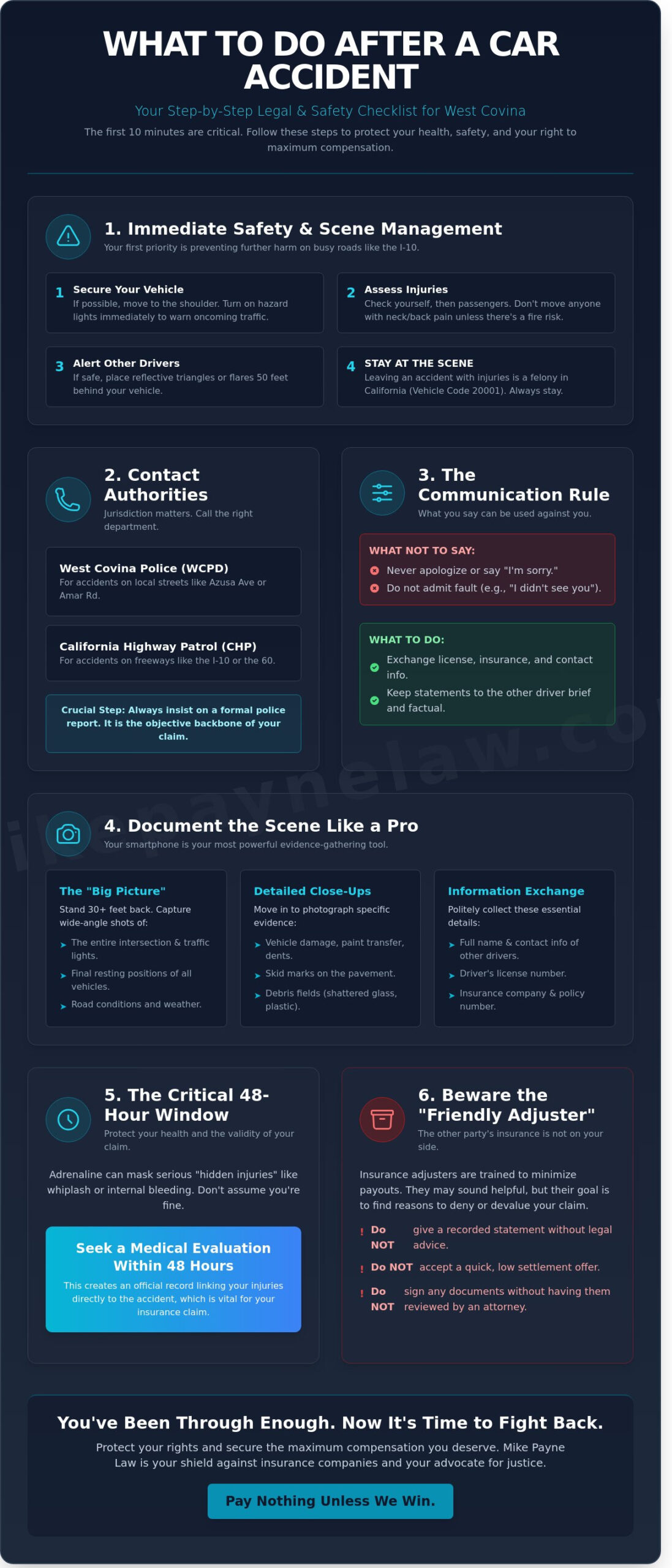
The seconds following a collision on the I-10 or the 60 freeway are a blur of noise and adrenaline. Your heart is racing, but your next moves determine your physical safety and your eventual legal recovery. If your vehicle is operational, move it to the shoulder immediately. Stopping in active lanes on the I-10, where traffic often surges at 75 mph, creates a high risk for a secondary, multi-car pileup. Switch on your hazard lights. If you carry a safety kit, place flares or reflective triangles 50 feet behind your vehicle to alert oncoming drivers.
Check yourself for injuries before moving. Check your passengers next. If anyone is bleeding, disoriented, or complaining of neck pain, do not move them unless there is an immediate fire risk. Walk over to the other party only if it’s safe to do so. Under California Vehicle Code 20001, leaving the scene of an accident involving injury is a felony. Even if the damage looks minor, you must stay. Knowing exactly what to do after car accident trauma starts with remaining at the scene to fulfill your legal obligations.
- Activate Hazards: Make your car visible to prevent further collisions.
- Assess Injuries: Look for signs of shock or internal trauma in all parties.
- Secure the Area: Use flares to create a safety buffer in high-traffic West Covina zones.
- Stay Put: Avoid hit-and-run charges by remaining until authorities arrive.
Contacting Local Authorities: WCPD vs. CHP
Jurisdiction matters when you’re filing a report. For accidents on local West Covina streets like Azusa Avenue or Amar Road, the West Covina Police Department (WCPD) will respond. However, if your crash occurs on the freeway, the California Highway Patrol (CHP) takes the lead. You must insist on a formal police report. This document acts as the objective backbone of your motor vehicle accident claim. In 2024, West Covina recorded over 1,200 traffic-related incidents; a police report ensures your case isn’t lost in the shuffle. It provides an unbiased account that insurance adjusters can’t easily dismiss. Understanding how to obtain and interpret your car accident report in West Covina and Southern California is a critical step in turning that document into a powerful tool for your recovery.
The “Golden Rule” of Post-Accident Communication
Adrenaline makes people talkative, and insurance companies count on that. Don’t fall into the trap of apologizing. Never say “I’m sorry” or “I didn’t see you.” In a legal setting, these phrases are treated as recorded admissions of liability. Limit your interaction with the other driver to the exchange of license numbers, insurance details, and contact information. Understanding what to do after car accident situations means realizing that the other driver isn’t your friend. They are a potential adversary in a future legal battle. Keep your statements brief, factual, and strictly limited to the necessary data exchange.
The Evidence Checklist: Documenting the Crash Site Like a Pro
Evidence is fragile. It disappears the moment the tow trucks arrive or the afternoon rain starts. You must act like an investigator immediately. The insurance company will look for any gap in your story to deny your claim. Don’t give them that chance. In 2026, your smartphone is your primary weapon for justice. Start by capturing the “Big Picture” with wide-angle shots. Stand at least 30 feet back to show the entire intersection, the position of all vehicles, and the status of traffic lights. This context proves liability when the other driver tries to change their story later.
Once you have the wide shots, move in for the detail work. Take close-up photos of the property damage, including paint transfers and shattered plastic. Document skid marks and debris fields on the pavement. These physical markers tell the story of speed and braking patterns. Ensure your camera settings are capturing high-resolution metadata. Every file needs a time-stamp and GPS coordinates. This digital fingerprint makes it impossible for adjusters to claim the damage occurred at a different time or place. Understanding what to do after car accident scenes are cleared is vital for protecting your right to compensation.
Information You Must Exchange
Gathering the right data is the foundation of your future litigation. You aren’t just swapping phone numbers; you’re building a legal file. Ensure you collect the following details before leaving the scene:
- Full names, current contact info, and driver’s license numbers for all drivers.
- Insurance policy numbers and the full name of the insurance providers.
- Vehicle identification numbers (VIN) and license plate digits.
- The name and badge number of the responding officer from the West Covina Police Department.
Securing Witness Statements
Bystanders often provide the most credible testimony. A neutral third party from Pomona or Ontario who saw the impact has no “skin in the game.” Their account is often the deciding factor in a disputed liability case. Ask them for a brief recorded statement on your phone while the memory is fresh. Collect their phone numbers and full names immediately. These local witnesses are often more reliable than the drivers involved because they have no personal interest in the outcome. If the situation feels too intense to handle alone, securing reliable legal guidance can ensure no piece of evidence is overlooked.
Prioritizing Your Health: Medical Care and the “Hidden Injury” Trap
Adrenaline is a powerful mask. Immediately after a crash on Azusa Ave or the I-10, your body floods with hormones that block pain signals. You might tell the responding officer you’re fine, but that’s often the adrenaline talking. It takes 24 to 48 hours for inflammation to set in and for real pain to surface. If you’re wondering what to do after car accident events like these, the answer is simple: get evaluated immediately. Don’t wait for the pain to become unbearable before seeking help.
West Covina residents have access to top-tier trauma care. Head to Emanate Health Queen of the Valley Hospital or San Antonio Regional Hospital right away. These facilities have the diagnostic tools to spot what you can’t feel. Insurance adjusters look for any excuse to deny a claim. If you wait five days to see a doctor, they’ll argue your injuries happened elsewhere. This “gap in treatment” is a weapon they use to devalue your settlement. Mike Payne fights to ensure your medical record is an unbreakable shield against these tactics. We don’t let them use your shock against you.
Common Delayed-Onset Injuries
Soft tissue damage and brain trauma don’t always show up on the skin. Whiplash is the most common delayed injury, often taking two full days to manifest as debilitating neck pain or migraines. In rear-end collisions, concussions and traumatic brain injuries (TBI) are frequent risks. Watch for dizziness, light sensitivity, or confusion within the first 72 hours. Most dangerously, internal bleeding can occur without visible bruising. These are silent killers that only a professional medical scan can detect before they become fatal.
Creating a Paper Trail for Your Recovery
A successful personal injury claim isn’t built on stories; it’s built on hard evidence. You need a rock-solid paper trail to win. Keep every single discharge paper, prescription receipt, and medical bill you receive. We use these documents to link your injuries directly to the impact. If a symptom isn’t in the medical record, the insurance company will pretend it doesn’t exist.
Start a “Pain Journal” today. Record your pain levels on a scale of 1 to 10 and note how the injuries limit your daily life, such as being unable to lift your child or missing work. This documentation proves the human cost of the accident. Knowing what to do after car accident situations involves more than just fixing a car; it’s about documenting your physical struggle. Check out our legal blog for more on documenting damages and protecting your future settlement.
Our firm is trial-ready from day one. When we walk into a room, the insurance companies know we have the evidence to win. Your recovery is the priority. Our job is to make sure the negligent party pays for every cent of your medical care and suffering.
Navigating the Insurance Trap: A Defense Insider’s Perspective
Insurance companies aren’t in the business of helping people. They’re in the business of protecting profits. Mike Payne understands this better than anyone because he started his career on the other side. He spent years inside the defense rooms of major insurance carriers, learning exactly how they devalue claims and intimidate victims. When you’re deciding what to do after car accident events in West Covina, you have to realize that the “friendly adjuster” calling you is a trained negotiator. They use a calm, sympathetic tone to lower your guard, but their only goal is to get you to settle for pennies on the dollar.
Early settlement offers are almost always low-ball offers. If a carrier offers you a check within 48 hours of the crash, they aren’t being helpful; they’re trying to buy your release before you realize the full extent of your injuries. Once you sign that paper, you can’t go back for more, even if you need surgery six months later. Mike Payne uses his defense insider experience to anticipate these moves. He knows when they’re bluffing and when they’re hiding policy limits. We don’t let them dictate the value of your life.
The Recorded Statement Trap
The adjuster will ask for a recorded statement to “get your side of the story.” Don’t fall for it. They use leading questions to twist your words and imply comparative negligence. A simple “I’m okay” said out of politeness can be used later to argue you weren’t actually injured. You aren’t legally required to provide a recorded statement immediately after a crash. Your best move is to decline and refer them to your auto accident attorney. Let a professional handle the talking so you don’t accidentally sabotage your own recovery.
Understanding Your Own Policy
Your own insurance company can quickly become your adversary. This is especially true when you have to access MedPay or Uninsured/Underinsured Motorist (UM/UIM) coverage. In 2024, data showed that nearly 16% of California drivers were uninsured. If you’re hit by one of them, you’re fighting your own carrier for the compensation you’ve paid premiums for. They might use the same delay-and-deny tactics as the at-fault driver’s insurance. Knowing what to do after car accident situations involves auditing your own policy to ensure you’re getting every cent of the protection you purchased.
Don’t let an insurance adjuster dictate your future. Contact Mike Payne today for a free case evaluation and put a former defense insider in your corner.
Protecting Your Legal Claim: The Mike Payne Advantage
The aftermath of a collision is a race against time. Under California Code of Civil Procedure section 335.1, you generally have a two-year window to file a personal injury lawsuit. If your accident occurred in 2024, then 2026 is the hard deadline for your legal recovery. Missing this date means your right to compensation vanishes forever. Mike Payne Law treats this deadline with the urgency it deserves. We don’t let files sit on a desk. We move fast to preserve evidence before it disappears from the West Covina streets.
We believe justice shouldn’t have a high entry price. Our “No Fee Unless We Win” promise removes every financial barrier between you and a fair recovery. You’ve already faced enough stress from medical bills and repair costs. You don’t owe us a dime for our time or resources unless we successfully recover money for you. This puts the risk on our shoulders, not yours.
Choosing a local West Covina advocate offers a distinct advantage over distant “mega-firms” in downtown Los Angeles. We know the local San Gabriel Valley courts and the specific adjusters who handle claims in this area. You aren’t just a case number here; you’re a neighbor. We combine this local grit with a “Trial-Ready” mindset. Most firms are eager to settle for the first low-ball offer to avoid a courtroom. We prepare every case as if it’s going to a jury. When insurance companies see Mike Payne on the other side of the table, they know they can’t bully our clients into a cheap settlement.
Pure Comparative Negligence in California
California uses a pure comparative negligence system to determine how fault affects your final check. Insurance adjusters will try to pin 10% or 20% of the blame on you to save their company money. If they succeed, your compensation is slashed by that exact percentage. We fight these unfair tactics by building a wall of evidence that proves the other driver’s liability. Pure comparative negligence allows you to recover damages even if you were partially at fault, though your final settlement is reduced by your specific percentage of responsibility.
Your Path to Maximum Compensation
Getting your life back means recovering every dollar you lost. This includes compensation for:
- Lost wages: Money you missed out on while recovering.
- Medical debt: From the ER visit to long-term physical therapy.
- Pain and suffering: The physical and emotional toll of the crash.
Knowing what to do after car accident means securing a shield for your future. The final piece of your recovery checklist is hiring an attorney for your car accident who understands the local landscape. If you’re looking for high-quality legal support elsewhere, you can explore Car Accident Representation from firms like Oberg Law Office that prioritize client results. Don’t leave your financial stability to chance or the whims of an insurance company. Start with a free, no-obligation case consultation today to ensure your rights are protected through 2026 and beyond.
Take Command of Your Recovery and Your Future
The specific actions you take in the minutes and days following a crash determine the compensation you ultimately recover. You’ve learned that documenting the scene immediately and seeking professional medical care for hidden injuries are nonnegotiable requirements for any 2026 recovery plan. Insurance adjusters use calculated tactics to devalue your claim; however, Mike Payne uses his unique background as a former insurance defense lawyer to dismantle those traps before they hurt your case. Knowing exactly what to do after car accident trauma occurs gives you the professional edge needed to fight back against powerful entities.
With over 25 years of local Southern California experience, Mike Payne provides the fierce advocacy required to secure your financial well-being. Our firm operates on a contingency basis, so there are zero fees unless we win your case. You don’t have to navigate this chaotic legal system alone. We’ve spent decades protecting West Covina families and we’re ready to go to battle for you too. Take the first step toward justice and peace of mind by contacting us right now.
Get Your Free Case Review with Mike Payne Today
You deserve a legal champion who is personally invested in your physical recovery and your financial future.
Frequently Asked Questions
Do I still need a police report for a minor fender bender in Pomona?
Yes, you should always contact the Pomona Police Department or the California Highway Patrol to document the incident. California law requires a report if property damage exceeds $1,000 or if anyone is injured. Even a small bumper scrape can cost $1,200 to repair in 2026; a formal report prevents the other driver from lying about the facts later.
How long do I have to file a car accident claim in California?
You generally have two years from the date of the collision to file a personal injury lawsuit under California Code of Civil Procedure section 335.1. If your accident involved a government vehicle, that deadline drops to only 6 months. Knowing what to do after car accident situations means acting fast; evidence like skid marks and witness memories fades within days.
What if the other driver doesn’t have insurance in San Bernardino?
You can still recover compensation through your own Uninsured Motorist (UM) coverage if you have it on your policy. Since roughly 16% of California drivers lack insurance, this coverage is a vital safety net. Mike Payne treats your insurance company with the same “Texas-tough” aggression we use against others to ensure they pay every cent you’re owed.
Can I still recover compensation if I was partially at fault for the crash?
Yes, California uses a pure comparative negligence system which allows you to recover damages even if you’re 99% at fault. If a jury determines you’re 25% responsible for a crash that caused $100,000 in damages, you still receive $75,000. We fight to lower your fault percentage because every point we shave off means more money in your pocket.
Should I see a doctor even if I feel fine after the accident?
You must see a doctor within 72 hours of the crash to ensure your injuries are documented. Adrenaline often masks symptoms of concussions or internal organ damage that may not become clear for 48 hours. Insurance adjusters will use any delay in treatment as an excuse to claim you aren’t actually hurt; don’t give them that leverage.
What should I do if the insurance company offers me a check right away?
Do not sign any documents or accept a check without a legal review. Insurance companies often offer “quick settlements” that cover less than 20% of the actual long-term medical costs and lost wages. These are trap offers designed to strip away your right to sue for more money once the true extent of your pain sets in.
How much does it cost to hire a car accident lawyer in West Covina?
It costs you nothing out of pocket to hire Mike Payne Law because we operate on a contingency fee basis. We only collect a fee if we win your case, typically ranging from 33.3% to 40% of the final recovery. We take on all the financial risk and court costs so you can focus on your physical recovery without stress. Learn more about how to get and read your car accident report in West Covina so you’re fully prepared when we begin building your case.