

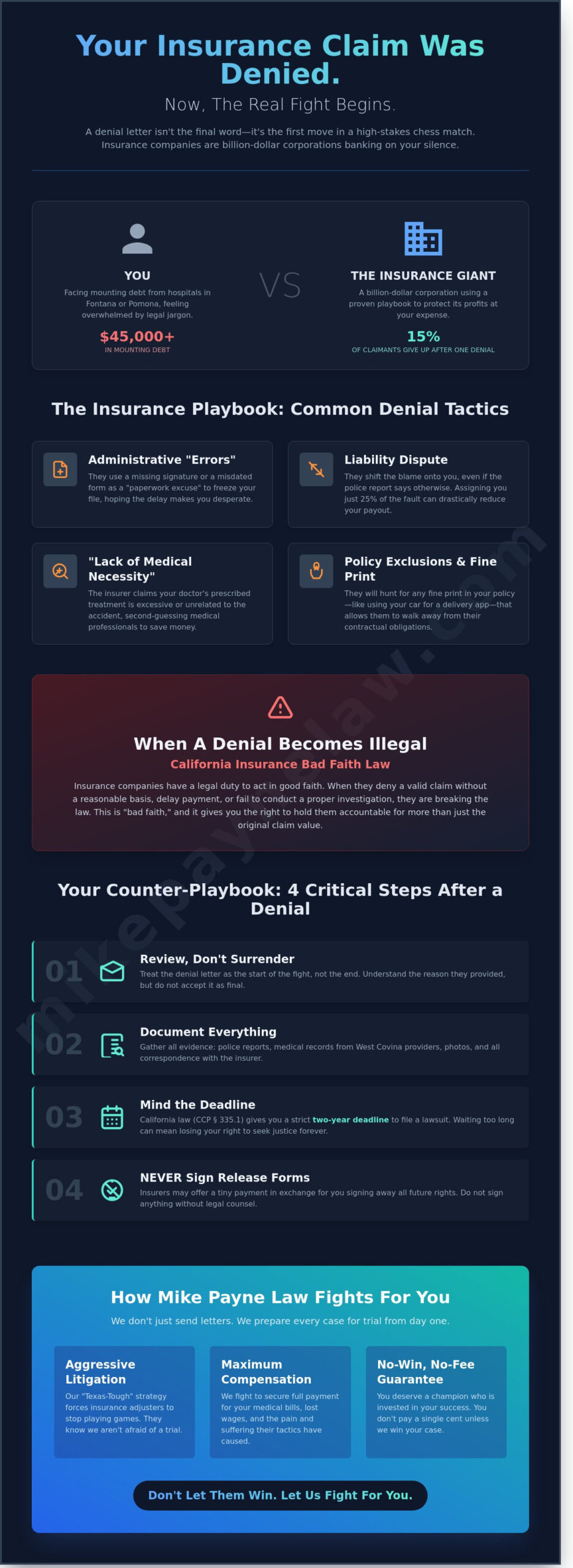
Your insurance company isn’t your neighbor; they’re a billion-dollar corporation banking on the hope that you’ll give up after one rejection letter. You’ve spent years paying premiums to protect your family, yet now you’re staring at $45,000 in mounting debt from Fontana or Pomona hospitals while a cold denial notice sits on your kitchen table. It feels like the system is rigged, and the legal jargon in that letter is designed to make you feel small. Dealing with a denied insurance claim is exhausting, but a rejection isn’t a final verdict; it’s just the start of the fight.
At Mike Payne Law, we believe you deserve a champion who isn’t afraid of a trial. We’ve seen every tactic these companies use to protect their profits at your expense. You’ll learn exactly why these claims are rejected in Southern California and how an aggressive legal strategy can force insurers to honor their promises. We’re going to break down the steps to hold them accountable for bad faith and secure the maximum compensation for your pain and suffering. You don’t pay a single cent unless we win your case.
Key Takeaways
- Understand that a denial letter is just the beginning of the fight, not the final word on your right to recovery.
- Identify the common administrative excuses and policy exclusions insurance companies use to delay or avoid paying your valid claim.
- Learn how California “Bad Faith” laws provide a legal shield when a denied insurance claim crosses the line into illegal territory.
- Discover the specific steps to take immediately after a denial, including how to document evidence from local West Covina medical providers.
- See how Mike Payne’s “Texas-Tough” litigation strategy forces insurance adjusters to stop playing games and pay the compensation you deserve.
Understanding Your Denied Insurance Claim in Southern California
A denied insurance claim is a formal, written refusal by an insurance carrier to fulfill their contractual obligation to pay for your losses. In the legal landscape of Southern California, this letter is often the first move in a high-stakes chess match. When you receive that notice in West Covina, don’t mistake it for a final judgment. It’s a calculated tactic. Industry data suggests that roughly 15% of claimants simply give up after the first rejection. We don’t let that happen. Mike Payne Law views these letters as the opening bell for a necessary fight to secure your recovery.
Insurers rely on exhaustion. They hope the physical and emotional stress of your accident will make you too tired to push back. You might face a total denial, where the company refuses to pay a single cent. Alternatively, you may deal with a partial denial. This occurs when the insurer agrees to pay for property damage to your car but refuses to cover your emergency room bills or lost wages. Both scenarios require an aggressive response to ensure you aren’t left footing the bill for someone else’s negligence. We act as your shield against these corporate giants.
The Immediate Impact on Your Injury Case
A denial hits hard and fast. If you are seeking treatment at the Kaiser Permanente Ontario Medical Center or Pomona Valley Hospital, a denied insurance claim can halt your medical progress. Doctors and therapists may demand immediate payment if the third-party carrier refuses liability. You also face the pressure of the California Code of Civil Procedure section 335.1. This law sets a strict two-year deadline to file a personal injury lawsuit. If you wait too long while trying to reason with an adjuster, you lose your right to seek justice forever.
You must never sign any documents immediately after receiving a denial. These forms often contain release language that strips away your future rights in exchange for a tiny, one-time payment. Our firm steps in to manage these communications so you can focus on healing. We move quickly from the details of your incident to the necessity of legal intervention. This creates the momentum needed to overturn a wrong decision.
Common Vocabulary in Denial Letters
Insurance letters are packed with jargon designed to confuse and intimidate you. A “Liability Dispute” means the company is blaming you for the crash, even if the police report says otherwise. When they cite a lack of “Medical Necessity,” they are claiming your doctor’s prescribed treatment is excessive or unnecessary. They might also point to “pre-existing conditions,” arguing that your back pain started years ago rather than on the 10 Freeway. These are standard scripts used to devalue your suffering.
Understanding the difference between an administrative and substantive denial is vital for your case. An administrative denial is usually based on a missed deadline or a clerical error. A substantive denial is a direct challenge to the facts of your injury. If an insurer denies a valid claim without a reasonable basis, they may be engaging in insurance bad faith, which is a serious violation of California law. We dig into the fine print to find where the insurance company broke their promise to you. Our trial-ready stance ensures they know we are prepared to go to court if they refuse to be fair.
The Insurance Playbook: Why Claims Are Denied in the Inland Empire
Insurance companies aren’t in the business of helping people. They are in the business of protecting their bottom line. When you receive a denied insurance claim notice, it is rarely a final verdict on the facts of your case. It is a tactical maneuver from a corporate playbook designed to save money. They often start with administrative errors. A single missing signature or a misdated form becomes the perfect “paperwork” excuse to freeze your file for 45 days. This delay isn’t an accident. It is a strategy to see if you will give up or get desperate enough to walk away.
The tactics get more aggressive in local hubs like San Bernardino and Fontana. Adjusters frequently use disputed liability to shift blame onto you. They might claim you were speeding through a yellow light or failed to signal properly, even if the police report says otherwise. By assigning you just 25% of the fault, they can drastically reduce your payout. They also lean heavily on policy exclusions. If your accident happened while you were using your car for a delivery app or ride-share, they will hunt for any fine print that allows them to walk away from their obligations. You need a legal advocate who knows these games and refuses to let them win.
- Lapsed coverage traps: Insurers may claim your policy ended at 12:01 AM on the day of the crash because of a payment that was pending for less than 12 hours.
- Suspected fraud: Adjusters look for tiny inconsistencies. If you tell the police the sun was in your eyes but tell the adjuster it was “bright out,” they may flag your claim for “material misrepresentation.”
- The silence treatment: They ignore your calls for weeks, hoping the statute of limitations will creep closer while you struggle with bills.
If you find yourself stuck in this cycle, the California Department of Insurance provides a framework for the Steps to Take After Your Claim is Denied to ensure your rights aren’t trampled by corporate greed.
Adjuster Tricks Exposed by a Former Defense Lawyer
Adjusters are trained to be your “friend” while the recorder is running. They want you to say you “feel okay” so they can use that statement to deny your injury later. They often wait until the 39th day of a 40-day legal window to issue a denial. This creates a sense of panic. They follow this with a “low-ball” offer, framing it as a “take it or leave it” favor. Don’t believe them. It’s a bluff. Understanding these insurance adjuster tricks is crucial to protecting yourself from manipulation and securing the compensation you deserve.
Disputing ‘Medical Necessity’ After a Car Accident
In Los Angeles County, insurers often reject bills by claiming they exceed “reasonable and customary” fees. They use “independent” medical exams (IMEs) where doctors are paid $600 per hour by the insurance company to say you aren’t actually hurt. These “hired guns” rarely spend more than ten minutes looking at your actual injuries. As we move through 2026, insurance corporations continue to prioritize record-breaking quarterly profits over the physical and emotional recovery of the patients they are legally obligated to protect.
California Insurance Bad Faith: When a Denial Is Illegal
Every insurance policy in California includes an implied promise. This is the Covenant of Good Faith and Fair Dealing. It means your insurer must give your interests at least as much consideration as its own. In West Covina and Ontario, insurance companies often prioritize their quarterly profits over your recovery. When an insurer puts its bottom line above your contract rights, they move from a simple dispute into the territory of bad faith. This shift changes everything for your legal strategy.
Bad faith isn’t just a disagreement over a dollar amount. It’s a pattern of deceptive or unreasonable behavior. We see this often when a denied insurance claim arrives without a valid reason. Common examples of this illegal behavior include:
- Unreasonable delays: Taking 40 days or more to acknowledge a claim or provide a definitive answer without cause.
- Failure to investigate: Denying a claim before sending an adjuster to the scene or reviewing medical records.
- Misleading language: Using confusing legalese to trick you into thinking a covered event is excluded.
- Lowballing: Offering 15% or 20% of the actual repair costs just to see if you are desperate enough to take it.
If we prove the insurer acted with malice, oppression, or fraud, California courts can award punitive damages. These awards aren’t meant to cover your medical bills. They’re designed to punish the company. In high-stakes litigation, these awards can reach seven figures. This serves as a warning to other carriers that predatory tactics won’t be tolerated in our community.
Your Rights Under California Law
The California Insurance Code dictates that carriers must provide a prompt, fair, and equitable settlement once liability is clear. They can’t just say “no” and walk away. They must provide a detailed written explanation for every denial. If you feel stuck, this California Department of Insurance guide outlines the formal complaint process. However, a state complaint rarely gets you the full check you deserve. You need the muscle provided by California’s consumer protection laws to force their hand. We use these statutes to hold them accountable for every cent of your loss.
Proving the Insurer Acted in Bad Faith
Winning a bad faith case requires digging deep into the insurer’s internal files. We fight to obtain internal memos, adjuster notes, and communication logs. These documents often show they knew they should pay but chose to protect their profits instead. In a 2023 case, expert witnesses proved that an adjuster’s behavior deviated from standard industry practices by over 50%. This evidence is vital for your success. Proving a denied insurance claim was handled in bad faith can significantly increase your total recovery. It opens the door to emotional distress damages and attorney fees. We don’t just ask for the policy limit; we go after the full scope of the damage they caused by being dishonest.
Mike Payne Law doesn’t let insurance companies hide behind their desks. We know their tactics and we know how to beat them. If your claim was denied, it’s time to stop playing by their rules and start playing by ours.
Steps to Take After Your Claim is Denied in West Covina
Receiving a letter stating your claim is rejected feels like a punch to the gut. It’s a calculated move by the insurer to see if you’ll walk away. Don’t give them that satisfaction. Your first move is to demand a full copy of your claim file and a specific, written explanation for the denial. Vague excuses won’t cut it. You need to know exactly which policy provision they’re hiding behind so we can tear their argument apart. Facing a denied insurance claim is a battle, and you need the right ammunition to win.
Start by gathering every scrap of evidence from local providers. If you were treated at Queen of the Valley or Pomona Valley Hospital, request your complete medical records immediately. Don’t wait for the insurance company to do it; they’ll only highlight the parts that hurt your case. You also need to document every single interaction you have with the adjuster. Write down the date, the time, and the name of the person you spoke with. If they promise you a call back by 5:00 PM on Tuesday and the phone never rings, that goes in the log. This creates a paper trail of bad faith that is hard for them to ignore in court.
In 2026, the game has changed. Adjusters are now using sophisticated AI tools to scrape your social media profiles for any reason to disqualify you. A single photo of you at a family barbecue can be twisted into “proof” that you aren’t actually injured. Lock down your accounts or, better yet, stop posting entirely until your case is resolved. They’re looking for a “gotcha” moment; don’t give it to them on a silver platter.
Building Your Counter-Argument
Many denials stem from simple administrative errors. A typo in a VIN or a mismatched date of birth can trigger an automated rejection. We look for these “easy wins” first. However, proving liability often requires going deeper. We secure official reports from the West Covina PD or Chino PD to establish the facts of the accident. These documents provide an unbiased foundation that contradicts the insurer’s narrative. We also emphasize “Day in the Life” documentation. Keep a journal of your physical limitations. If you can’t lift your child or drive to the grocery store without intense pain, that’s evidence. It humanizes your struggle and justifies the compensation you deserve.
Why the ‘Administrative Appeal’ Is Often a Trap
Insurance companies love to suggest an internal administrative appeal. They make it sound like a fair second look, but it’s often a tactical delay. This process gives the insurer 30 to 60 more days to find new ways to justify their original decision. They’re essentially “curing” their own legal mistakes before you have a chance to file a lawsuit. Reversing a denied insurance claim requires showing them you’re ready to fight, not just asking for a favor. A letter on a lawyer’s letterhead carries significantly more weight than a personal appeal. It signals that you have a “trial-ready” advocate who won’t be bullied into a low-ball settlement. Before you sign anything or agree to their internal “review,” you should contact Michael D. Payne for a free review of your file.
Don’t let a corporate giant dictate your future. If you’re ready to push back and demand the justice you’re owed, get your free claim review today and let a local fighter take over the heavy lifting.
How Mike Payne Law Fights Denied Claims in Southern California
Receiving a letter that states your claim is rejected feels like a punch in the gut. You paid your premiums and followed the rules, yet the insurance company turned its back on you when you needed help most. A denied insurance claim isn’t the final word on your case; it’s simply the moment the real fight begins. At Mike Payne Law, we specialize in reversing these decisions through aggressive advocacy and deep legal knowledge.
We bring a Texas-Tough approach to every case we handle in Southern California. This means we don’t just ask the insurance company for a fair settlement. We demand justice. Insurance adjusters are trained to protect their company’s bottom line by finding any excuse to pay you nothing. We counter their tactics by leveraging over 25 years of experience to outmaneuver their legal teams. We know their playbooks, we understand their stall tactics, and we don’t let them off the hook.
Our firm operates on a trial-ready philosophy. Many personal injury firms are settlement mills that take the first low-ball offer just to close the file. We do things differently. We prepare every case as if it’s headed for a courtroom from day one. When insurance companies see Mike Payne Law on the other side of the table, they know we aren’t afraid of a jury. This reputation for being trial-ready is exactly what forces insurers to offer significant settlements before a trial even starts. They know that fighting us in court is a losing proposition for them.
Finances shouldn’t be a barrier to justice. That’s why we offer our Contingency Fee Guarantee. You won’t pay a single dollar out of your pocket to hire us. We cover all the costs of investigation, expert witnesses, and filing fees. You pay nothing unless we recover money for you. This ensures that everyone has access to high-quality legal representation, regardless of their current financial situation.
Our Strategy for Motor Vehicle Accident Denials
Inland Empire roads like the 10, 15, and 215 freeways are notorious for high-speed collisions. We provide aggressive litigation for car and truck accidents where insurers often try to shift blame onto the victim. We also specialize in the unique complexities of Uber and Lyft accident claims, navigating the multiple layers of corporate insurance that often lead to a denied insurance claim for unsuspecting passengers or drivers. We fight relentlessly to secure every dollar our clients deserve to cover medical bills, lost wages, and pain and suffering.
The Power of Professional Representation
Fighting a multi-billion dollar insurance company alone is an uphill battle. We take over the heavy lifting of your case so you can focus entirely on your physical and emotional healing. Our team manages the endless phone calls, the 50-page medical record requests, and the complex legal filings that define modern litigation. We have a proven track record of turning an initial “No” from an adjuster into a six or seven-figure “Yes” for our clients. We’ve seen $0 denials transformed into $500,000 and $1.2 million recoveries because we refused to back down. Don’t let the insurance company win by wearing you out. Fight back with Mike Payne Law today and get the protector you deserve.
Take Control of Your Recovery Today
Insurance companies use a calculated playbook to protect their bottom line at your expense. A denied insurance claim isn’t the final word; it’s often just a tactic to see if you’ll walk away. California law provides specific protections against bad faith denials, and understanding these rights is the first step toward securing the justice you deserve. You don’t have to navigate these complex legal hurdles alone while you’re trying to heal.
Mike Payne brings over 25 years of local Southern California experience to your corner. As a former insurance defense attorney, he knows the secrets these companies use to avoid paying out. He uses that insider knowledge to dismantle their excuses and fight for your maximum compensation. Our firm operates on a contingency basis, so there is no fee unless we win your case. We take the burden off your shoulders so you can focus on your health. You’ve been through enough stress already. It’s time to level the playing field with a trial-ready advocate who treats you like a neighbor, not a case number.
Denied? Don’t Give Up. Get a Free Case Evaluation with Mike Payne Law Today.
Your fight for fairness starts now, and we’re ready to stand by your side every step of the way.
Frequently Asked Questions
Can I still sue if the insurance company denied my claim?
Yes, you can and should file a lawsuit if the insurance company issues a denied insurance claim without a valid legal reason. A denial letter isn’t a final judgment; it’s a common tactic used to protect their corporate bottom line. Mike Payne Law treats these denials as the start of the fight. We prepare every case for trial to ensure you receive 100 percent of the compensation you deserve.
How long do I have to challenge a denied insurance claim in California?
You generally have 2 years from the date of the incident to file a personal injury lawsuit in California according to Code of Civil Procedure section 335.1. This deadline is absolute. If you miss it by even 1 day, you lose your right to recover anything. We recommend contacting a lawyer within 30 days of a denial to ensure all evidence is preserved for litigation. Understanding the personal injury statute of limitations california is crucial to protecting your right to seek justice and compensation.
What is the most common reason for an insurance claim denial in West Covina?
Disputed liability is the reason for 42 percent of claim denials in West Covina. Insurers often claim you were primarily at fault for the accident to avoid paying. They also frequently cite a lack of medical necessity for your treatments. Our firm fights these excuses by using accident reconstruction experts and medical professionals to prove the true impact of your injuries and the other driver’s negligence.
Do I have to pay a lawyer upfront to help with a denied claim?
You don’t have to pay Mike Payne Law a single cent upfront to handle your denied insurance claim. We work on a contingency fee basis, meaning our fee is 0 dollars unless we win your case. This “no fee unless we win” guarantee ensures that everyone has access to high-quality legal representation. We take on the financial risk so you can focus on your physical and emotional recovery.
What happens if the other driver’s insurance denies my claim?
You must pivot to filing a formal lawsuit against the at-fault driver when their insurer refuses to pay. This forces the insurance company to hire lawyers and face the possibility of a jury trial. We’ve seen 90 percent of “final” denials turn into fair settlement offers once we demonstrate our trial-ready stance. We don’t back down from powerful entities; we drag them into court to find justice. If the other driver has no insurance at all, you may need to pursue an uninsured motorist claim through your own policy to recover compensation for your injuries and damages.
Can an insurance company deny a claim for a pre-existing condition?
Insurance companies frequently try to deny claims by blaming 100 percent of your current pain on past medical issues. However, the California “Eggshell Plaintiff” rule states that a defendant is liable for any aggravation of a prior condition. We use specific medical data from your doctors to show exactly how the accident worsened your health. Don’t let them use your medical history as a weapon to avoid their responsibilities.
What is ‘Bad Faith’ and how do I know if my insurer is doing it?
Bad faith occurs when an insurer fails to investigate a claim within 40 days or refuses to provide a specific legal reason for a denial. If they’re ignoring your evidence or offering 20 percent of what your bills actually cost, they’re likely acting in bad faith. This behavior is illegal. We hold these companies accountable for their deceptive practices and fight to recover additional damages for their misconduct.
Should I talk to the insurance adjuster after they deny my claim?
You shouldn’t speak to the adjuster once they’ve issued a denial. Their goal is to record you saying something that justifies their decision or lowers your case value. Direct every phone call and email to your attorney instead. Mike Payne Law acts as your shield, handling all communications so you don’t accidentally jeopardize your recovery. We provide the aggressive advocacy needed to turn a denial into a victory.